The then-and-there contest
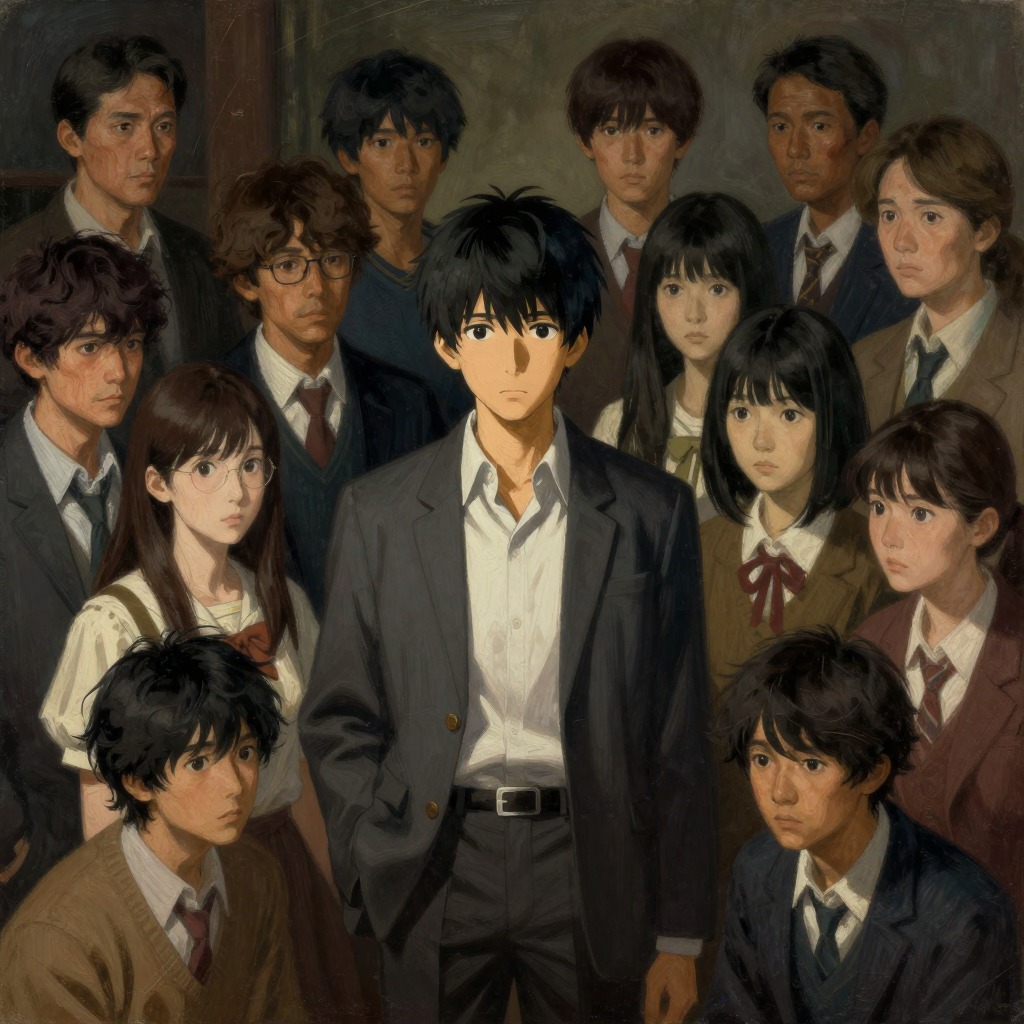
The then-and-there contest is a philosophical concept that crystallizes in Yozo's mind during his time living above a bar in Kyobashi, marking a crucial shift in his understanding of human society and his place within it. For most of his life, Yozo had been paralyzed by a vague, overwhelming terror of "society," which he imagined as a powerful, inscrutable ocean capable of crushing him at any moment. This fear drove his compulsive clowning and his desperate attempts to appease everyone he met. However, through his interactions with Masao Horiki and his observations of the world, Yozo begins to formulate a new theory: society is not a monolithic entity but merely a collection of individuals, and the struggle of life is not against an abstract force but a series of immediate, then-and-there contests between one person and another. He concludes that "the incomprehensibility of society is the incomprehensibility of the individual" and that "the ocean is not society; it is individuals." This realization grants him a measure of freedom from his paralyzing dread, allowing him to behave more aggressively and respond to the needs of the moment without endless anxious worrying.
Origin and Development of the Concept
The concept emerges from Yozo's long history of feeling alienated and terrified by human interaction. From childhood, he was unable to understand the motives of others, including his own family, and he developed his clowning as a desperate strategy to navigate a world he found baffling and menacing. His experiences with the Reading Society, where he performed farce for comrades who took themselves with life-and-death seriousness, and his friendship with the cynical Horiki, who treated him as a "living corpse," gradually eroded his belief in a unified, judgmental "society." The decisive moment comes when Horiki lectures Yozo, warning him that "society won't stand for" his behavior. Yozo silently retorts, "It's not society. You're the one who won't stand for it—right?" This internal challenge leads him to the conviction that "what is society but an individual?" From that point, he begins to act more in accordance with his own inclinations, becoming, as Shizuko notes, "rather self-willed and not so timid as before."
Application and Consequences
Yozo puts his new philosophy into practice most dramatically when he leaves Shizuko's apartment in Koenji. Instead of offering explanations or fearing societal retribution, he simply tells the madam of the bar in Kyobashi, "I've left her and come to you." He reflects that this single then-and-there contest had been decided, and that "society" inflicted no harm on him. This approach allows him to live for a time with a semblance of ease, treating each interaction as a discrete battle rather than a judgment by an omnipotent world. However, the concept proves tragically insufficient. When he decides to marry Yoshiko, he does so impulsively, thinking of it as another then-and-there decision: "I made up my mind on the spot: it was a then-and-there decision, and I did not hesitate to steal the flower." The subsequent suffering—Yoshiko's violation and Yozo's own descent into morphine addiction—shatters this simplistic framework. He realizes that "the 'world,' after all, was still a place of bottomless horror. It was by no means a place of childlike simplicity where everything could be settled by a single then-and-there decision."
Thematic Significance
The then-and-there contest represents Yozo's most sophisticated attempt to rationalize and control his terror of human beings. It is a fragile, intellectual construct that momentarily liberates him from his paralyzing fear but ultimately cannot withstand the complexities of love, trust, and betrayal. The concept's failure underscores the novel's central theme: that human suffering cannot be reduced to a series of manageable contests, and that Yozo's fundamental alienation—his sense of being "disqualified as a human being"—is too deep to be resolved by any philosophical formula. The idea also highlights the novel's critique of social conformity, suggesting that the fear of "society" is often just the fear of specific individuals, a realization that brings Yozo a brief, deceptive sense of power before his world collapses again.